
- Interactive 3D technology
- Use cases
-
Case studies
-
-
- Fashion
- Zegna X
-
- Automotive
- PEI Mobility
- UP Design
-
-
- Resources
- FAQ
- The Company
- Contacts
Virtual and augmented reality are two immersive technologies that are redefining the way we interact with the digital world. While they share the goal of enriching our experience through digital elements, they do so in fundamentally different ways. These technologies are no longer confined to research labs or video games; they are transforming sectors such as medicine, architecture, training, and retail, offering new possibilities for visualization, interaction, and communication.

What is virtual reality (VR)
Virtual reality is a technology that creates a fully immersive environment, replacing the real world with a computer-generated one. Imagine putting on a headset and instantly finding yourself transported to another place: this is the essence of VR. Unlike watching a screen, where you are always aware of the separation between yourself and the content, virtual reality surrounds you completely, creating the illusion of being physically present in a digital world.

VR works with dedicated headsets (such as Oculus Quest, HTC Vive, or PlayStation VR) that isolate the user from the surrounding environment, presenting stereoscopic images that create the perception of depth. Motion sensors track the position of the head and, in more advanced systems, of the hands and body as well, enabling natural interactions with the virtual environment.
Immersion is the defining feature of virtual reality: when you put on a VR headset, your brain is “tricked” to the point of reacting to virtual stimuli as if they were real. This can generate authentic emotional responses, making VR particularly effective for experiences that require deep engagement, such as training simulations, phobia therapies, or immersive narrative experiences.
What is augmented reality (AR)
Immersion is the defining feature of virtual reality: when you put on a VR headset, your brain is “tricked” to the point of reacting to virtual stimuli as if they were real. This can generate authentic emotional responses, making VR particularly effective for experiences that require deep engagement, such as training simulations, phobia therapies, or immersive narrative experiences.
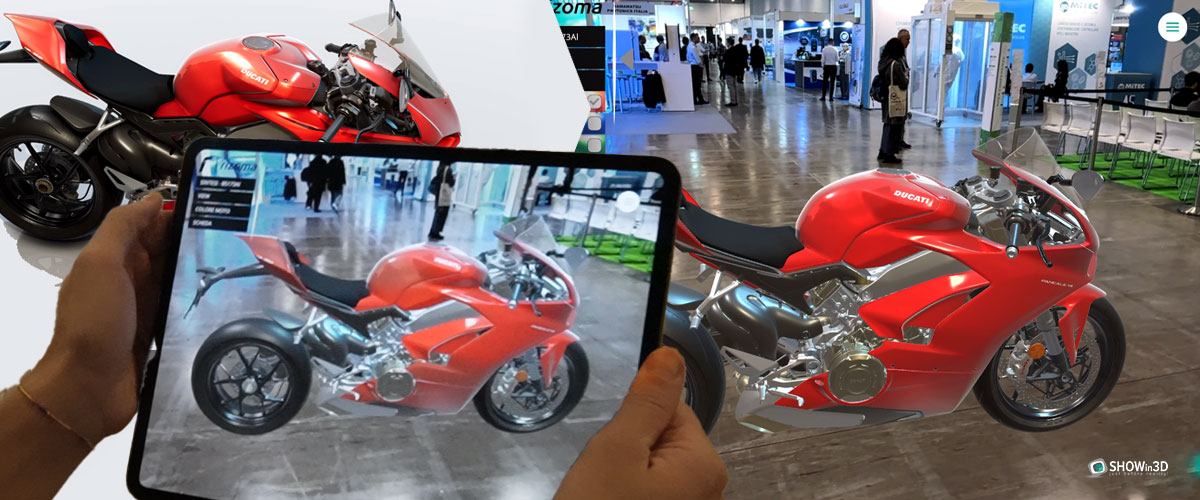
AR works through devices that preserve the view of the surrounding world, such as smartphones, tablets, or see-through headsets (such as Microsoft HoloLens or Magic Leap). These devices use cameras to “see” the environment, sensors to map it, and screens or lenses to overlay contextual digital content.
The strength of augmented reality lies in its accessibility and its ability to provide contextual information. It does not necessarily require specialized hardware (most modern smartphones support AR applications) and keeps the user connected with the surrounding environment, making it ideal for everyday applications such as navigation, assisted shopping, or guided maintenance.
Comparison between virtual and augmented reality
The differences between these technologies go beyond hardware and profoundly influence their applications:
| Feature | Virtual Reality (VR) | Augmented Reality (AR) |
|---|---|---|
|
Immersion |
Complete (fully virtual environment) |
Partial (virtual elements on the real world) |
|
Awareness of surroundings |
Absent or limited |
Maintained |
|
Main devices |
Dedicated headsets that isolate from reality |
Smartphones, tablets, see-through headsets |
|
Social interaction |
Social interaction |
Can take place naturally in the real world |
|
Ideal applications |
Simulations, immersive training, entertainment |
Field service, product visualization, navigation |
There is also a third category, Mixed Reality (MR), which represents a middle ground where virtual objects not only overlay the real world but interact with it, anchoring themselves to physical surfaces and reacting to the surrounding environment.
Practical applications

These technologies are revolutionizing numerous sectors:
- Industry and manufacturing: VR makes it possible to design and test products in virtual environments before physical production, reducing development costs and time. AR supports assembly and maintenance operations, showing instructions overlaid on real components and enabling remote assistance from experts.
- Architecture and design: architects use VR to let clients “walk” through buildings that have not yet been built, allowing them to experience the spaces and make changes before work begins. AR makes it possible to visualize how new furnishing elements would fit into existing spaces.
- Medicine and healthcare: surgeons train with VR simulations of complex procedures, while AR can overlay diagnostic information (such as scans) directly on the patient during real procedures. VR is also used for therapies for phobias, post-traumatic disorders, and pain management.
- Training and education: students can explore virtually reconstructed historical sites or visualize abstract concepts in three-dimensional form. AR enriches textbooks with interactive content and enables safe, affordable virtual lab experiences.
- Retail and marketing: virtual stores enable immersive shopping experiences from home, while AR lets customers “try” products such as furniture, eyewear, or clothing before buying, reducing returns and increasing customer satisfaction.
Visualization with SHOWin3D
Platforms such as SHOWin3D by Shin Software transform the 3D visualization experience, making these technologies accessible even to those without advanced technical skills. SHOWin3D is not a VR/AR authoring tool, but a solution that lets you:
- Visualize 3D models with real-time photorealistic rendering
- Explore products from every angle with immediate interaction
- Configure variants and customizations with instant updates
- Share interactive 3D experiences via simple web links
This platform acts as a bridge between traditional 3D modeling and immersive experiences, allowing companies to take advantage of advanced visualization without the technical complexity typically associated with virtual and augmented reality.
Virtual and augmented reality continue to evolve rapidly, with devices that are increasingly powerful, lightweight, and accessible. Integration with other technologies such as artificial intelligence, 5G, and the Internet of Things promises to further expand their applications, bringing us closer to a future where the boundary between digital and physical will be increasingly blurred.
Related terms
Platforms such as SHOWin3D by Shin Software transform the 3D visualization experience, making these technologies accessible even to those without advanced technical skills. SHOWin3D is not a VR/AR authoring tool, but a solution that lets you:
- HMD headsets (Head-Mounted Display) – Head-worn devices containing one or two displays positioned in front of the eyes, used mainly for virtual reality experiences.
- Spatial tracking – Technology that monitors the user’s position and movements in physical space, essential for creating natural interactions in VR and AR environments.
- Real-time rendering – The process of generating digital images fast enough to create the illusion of smooth motion, fundamental for responsive VR/AR experiences.
- Metaverse – The concept of a shared, persistent virtual space where users can interact with each other and with digital elements through avatars, considered a possible evolution of the internet.
- Haptic feedback – Technology that recreates the sense of touch through vibrations, forces, or movements, enriching the immersive experience with physical feedback in response to virtual interactions.