
- Interactive 3D technology
- Use cases
-
Case studies
-
-
- Fashion
- Zegna X
-
- Automotive
- PEI Mobility
- UP Design
-
-
- Resources
- FAQ
- The Company
- Contacts
Training technical staff to operate and maintain industrial machinery is one of the most critical and costly processes in a manufacturing organization.
Traditional methods — on-the-job shadowing, paper manuals, classroom training — have structural limits in terms of scalability, safety, costs and speed of skills transfer.
Adopting Digital Twin 3D as a training tool introduces a radical paradigm shift. A high-fidelity digital replica of a machine — able to simulate its appearance, behavior, components and operating procedures — transforms learning from a passive experience into active, immersive and measurable interaction.

A Digital Twin 3D is not a generic simulation: it is the exact replica of a specific machine, with its actual components, operating sequences and technical critical points. This level of fidelity is what makes virtual training equivalent — and in many cases superior — to training on the real machine.
Advantages in Training Time
Reducing time-to-competency, that is, the time an operator needs to reach an autonomous and safe level of operation, is one of the most immediate and measurable impacts of adopting Digital Twin 3D as a training tool.
Non-sequential
and on-demand learning
In traditional training, the operator learns by following a rigid sequence dictated by the availability of the trainer and the machine. With Digital Twin 3D, the digital twin is available at any time, on any device, enabling:

REPETITION
Immediate repetition of procedures without waiting for the real machine to become available.
AUTONOMY
Self-paced study of specific sections based on each operator's individual difficulties.
MODULARITY
Modular-length training sessions that can fit into periods of lower production load.
| Training method | Average time to first autonomous use | Average sessions required |
|---|---|---|
|
On-the-job shadowing
|
3-5 weeks |
8-12 sessions |
|
Manual + video |
5-7 weeks |
15-20 sessions |
|
Digital Twin 3D |
1-2 weeks |
4-6 sessions |
The data in the table are based on industry benchmarks for complex industrial machinery. Actual results may vary depending on the complexity of the machine and the operator's starting profile.
Fewer training iterations
Immersive interaction with the Digital Twin 3D triggers more effective procedural memory mechanisms than reading manuals or watching training videos. Being able to explore the machine in three dimensions, disassemble components virtually and perform procedures step by step significantly reduces the number of sessions needed before the operator becomes fully autonomous.
Economic Advantages
The economic impact of adopting Digital Twin 3D 3D for industrial training shows up on several levels: from lower direct training costs, to less machine downtime, to fewer accidents and operating errors and the costs associated with them.
Lower direct training costs
Traditional training on industrial machinery involves significant and often underestimated costs:
- Cost of a specialized trainer per session (high daily rate for technicians with expertise on specific machines).
- Cost of machine time taken away from production during training sessions.
- Travel and accommodation costs for trainers or for operators traveling to training centers.
- Cost of producing and updating physical training materials (manuals, technical sheets, illustrated plates).
Digital Twin 3D eliminates or drastically reduces all of these items: once the digital twin has been created, training sessions can be delivered to an unlimited number of operators with no additional variable costs.

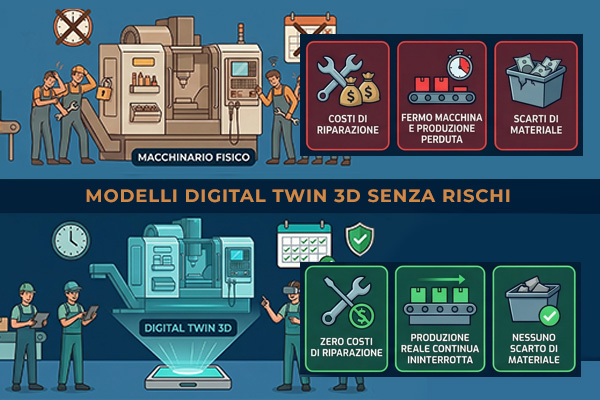
No more costs from errors and accidents during learning
Errors made by trainee operators on real machines have an immediate direct cost: component failures, unplanned downtime, production scrap and, in the worst cases, accidents causing harm to people or equipment. On the digital twin, any procedural error has no physical consequences, completely eliminating this category of economic risk.
A single unplanned machine stoppage in a medium-sized production plant can cost anywhere from a few thousand to tens of thousands of euros per hour of downtime. Training on Digital Twin 3D removes any chance that training errors will trigger such events.
Optimizing training ROI
Training content built around the Digital Twin 3D is a reusable digital asset whose marginal cost approaches zero with each subsequent use. Unlike the fixed costs of traditional training — which are repeated in full for every new operator or every update — the initial investment in creating the digital twin is progressively amortized over every training session delivered.

SCALABILITY
the same Digital Twin 3D trains 1 or 1,000 operators at the same infrastructure cost.
REUSE
the digital twin is accessible from any plant or geographic branch.
LONGEVITY
The Digital Twin 3D can be updated incrementally without needing to be completely rebuilt.
Logistical Advantages
The logistics of industrial training are one of the biggest sources of inefficiency in the HR and operations processes of manufacturing companies. The need to coordinate people, spaces, machinery and schedules creates structural bottlenecks that Digital Twin 3D solves at the root.
Independence from the physical availability of the machine
In traditional training, the machine must be physically available and not in production to be used for training purposes. This creates direct competition between production and training needs, which is usually resolved at the expense of training. With Digital Twin 3D:
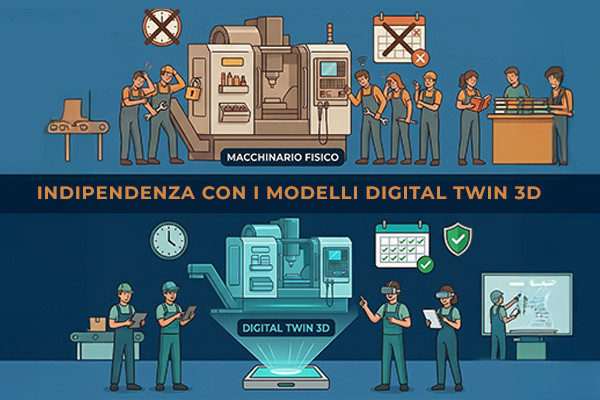
INDEPENDENCE
Training takes place in parallel with production, without interfering with the line.
CONTINUITY
There is no need to interrupt production cycles to schedule training sessions.
ANTICIPATION
Machines that are on order or not yet physically installed can already be used for training through their digital twin.
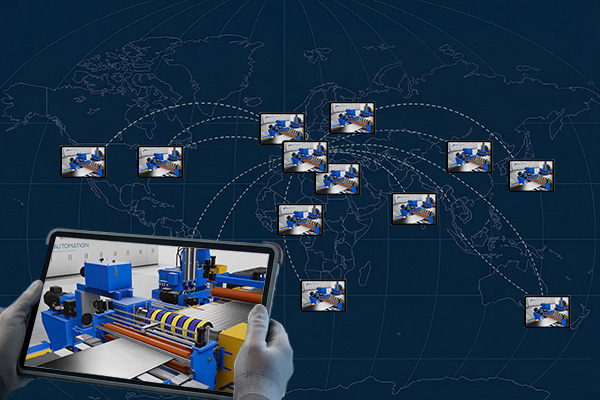
Geographically distributed training
For organizations with multiple production sites, with dealer and service networks spread across the territory, or that need to train service technicians in different geographic areas, the logistics of centralized training are prohibitively expensive. The Digital Twin 3D is accessible from any connected device, making training:
AVAILABILITY
Available at all branches and plants without having to move trainers or machinery.
USABILITY
Usable by international distributors and partners in their native language, thanks to the platform's multilingual support.
ACCESSIBILITY
Accessible to field service technicians for updates on new versions or procedures.
Removing scale barriers in training
When a company grows quickly, hires new staff or faces significant turnover, traditional training methods do not scale: every new operator requires the same investment of time and resources as the first. Digital Twin 3D enables training capacity to grow linearly with the organization, without proportional cost increases.

Safety Advantages
Workplace safety is an absolute priority in industrial environments. Training is one of the main accident-prevention tools, yet training itself — when conducted on real machinery with inexperienced operators — carries intrinsic risks. Digital Twin 3D eliminates this structural contradiction.
A zero-risk learning environment
On the digital twin, the trainee operator can:
REPEATABILITY
Perform startup, emergency stop and reset procedures without any physical risk.
FAULT SIMULATIONS
Simulate abnormal conditions and malfunctions in a controlled way, learning the correct responses without exposure to real danger.
PRACTICE
Repeat safety sequences until fully mastered, without the time pressure typical of shadowing on the real machine.
VIRTUAL LEARNING
Learn the correct handling of protective devices and lockout/tagout procedures in a virtual environment before physically accessing the machine.
Fewer injuries during learning
Most injuries on industrial machinery occur in the first weeks of use by operators who have not yet fully internalized the safety procedures. Extensive training on Digital Twin 3D — which can cover hundreds of operating scenarios before the first access to the real machine — drastically shortens this risk window.

Immersive training with Digital Twin 3D can be precisely documented and tracked: every session, every completed procedure and every error made is recorded, giving the company documented evidence of the skills operators have acquired before accessing the machinery.
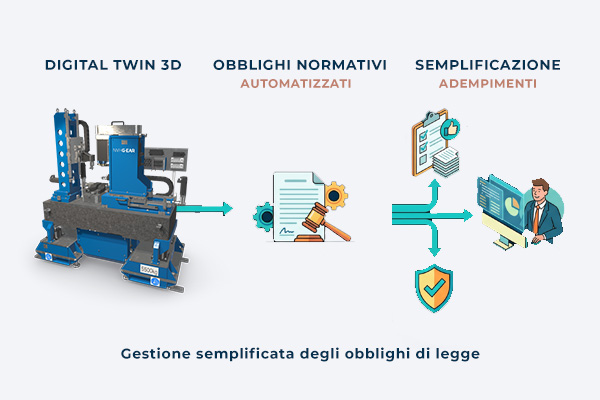
Regulatory compliance and training records
Under the regulations (Italian Legislative Decree 81/2008 and related technical standards), companies are required to document the training delivered to operating staff. The Digital Twin 3D, integrated with the training management platform, provides automatic logs of completed sessions, passed modules and assessments carried out, simplifying compliance with legal obligations.
Cognitive and Retention Advantages
Beyond the operational and logistical benefits, Digital Twin 3D acts directly on the cognitive mechanisms of learning, producing deeper understanding and better long-term retention than traditional training methods.

Active learning vs. passive learning
Research in the neuroscience of learning consistently documents the superiority of active learning — based on interaction, exploration and immediate feedback — over passive learning based on reading or listening. Digital Twin 3D by its nature requires an active approach: the operator does not read about a component, they handle it; they do not listen to a procedure, they perform it.
RATE
Retention rate after 7 days: 65–75% with active methods vs. 10–15% with passive methods (source: Learning Pyramid research).
FEEDBACK
Immediate feedback on procedural errors consolidates the correct operating sequences more effectively than external observation.

Three-dimensional understanding of the machine
Understanding the internal structure of a complex machine — the relative position of components, maintenance paths, hazard zones — is inherently three-dimensional. Two-dimensional manuals and videos impose an additional cognitive effort of “translating” from a flat representation to 3D reality. Digital Twin 3D closes this gap: the operator explores the machine in the same three-dimensional space in which they will work.
Customized training paths
The Digital Twin 3D platform makes it possible to structure differentiated training paths by operator profile, level of experience and specific role. A maintenance technician, a line operator and a commissioning technician have different training needs on the same machine: the Digital Twin can be configured to present specific modules to each profile, optimizing training time and avoiding cognitive overload from irrelevant information.

Organizational Scalability
Digital Twin 3D is not just a tool for the individual operator: it is a training infrastructure that scales with the organization and becomes progressively more valuable as its adoption grows.
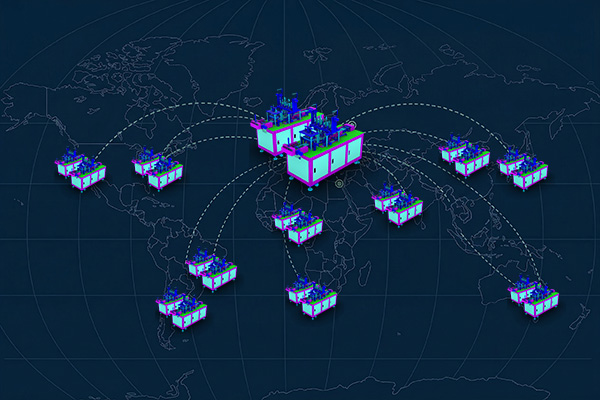
Standardizing procedures globally
In organizations with distributed production sites — including internationally — ensuring standardized operating procedures is an ongoing challenge. Digital Twin 3D centralizes the “reference” version of every procedure: all operators at all sites train on the same digital twin, eliminating local procedural drift and ensuring operational uniformity.
Transferring know-how from experts to new operators
The loss of operational know-how due to the retirement or rotation of experienced staff is one of the greatest strategic risks for manufacturing companies. Digital Twin 3D can incorporate the optimal procedures developed by the most experienced operators — including practices not documented in the official manuals — turning tacit knowledge into a structured and permanent training asset.

Scalability and technological continuity
Our platform is built on scalable cloud infrastructure, based on Amazon AWS with certified security protocols and continuous access monitoring. This architecture makes it possible to expand the content catalog, increase the number of concurrent users and add new geographic markets without structural changes to the existing implementation.
The initial technology investment becomes a digital asset that grows and adapts over time, staying in step with the evolution of products, business processes and enabling technologies.

Integration with training management systems (LMS)
Shin Software's Digital Twin 3D platform can integrate with corporate LMS (Learning Management System) platforms, enabling:
TRACKING
Automatic tracking of training module completion.
ASSESSMENTS
Assessment of acquired skills through procedural tests built into the digital twin.
REPORTING
Aggregate reports for HR and HSE managers on training progress by department, site or role.
CERTIFICATIONS
Digital certification of acquired skills, with a complete audit trail.