
- Interactive 3D technology
- Use cases
-
Case studies
-
-
- Fashion
- Zegna X
-
- Automotive
- PEI Mobility
- UP Design
-
-
- Resources
- FAQ
- The Company
- Contacts
Lighting effects in 3D rendering are the set of techniques and algorithms used to simulate the behavior of light in three-dimensional virtual environments. These effects are essential for turning “bare” geometric models into realistic, engaging images that can convey atmosphere, depth, and materiality.

Unlike traditional photography, where light is captured from a real scene, in 3D rendering light has to be simulated mathematically. This simulation can range from simple approximations to physically accurate calculations that trace the path of millions of virtual light rays, recreating complex phenomena such as reflections, refractions, shadows, and light scattering.
Lighting effects are often the difference between a basic render and a photorealistic one. A 3D model can be geometrically perfect, but without appropriate lighting it will look flat and artificial. It is light that reveals textures, emphasizes volumes, creates depth, and conveys emotions, turning mathematical data into convincing visual experiences.
Fundamentals of lighting effects in 3D rendering
In the real world, light travels in a straight line until it meets a surface. At that point, it can be absorbed (converted into heat), reflected (bounced in a new direction), or refracted (bent as it passes through transparent materials). The most advanced rendering engines simulate these behaviors by following physical principles such as energy conservation and the laws of optics.
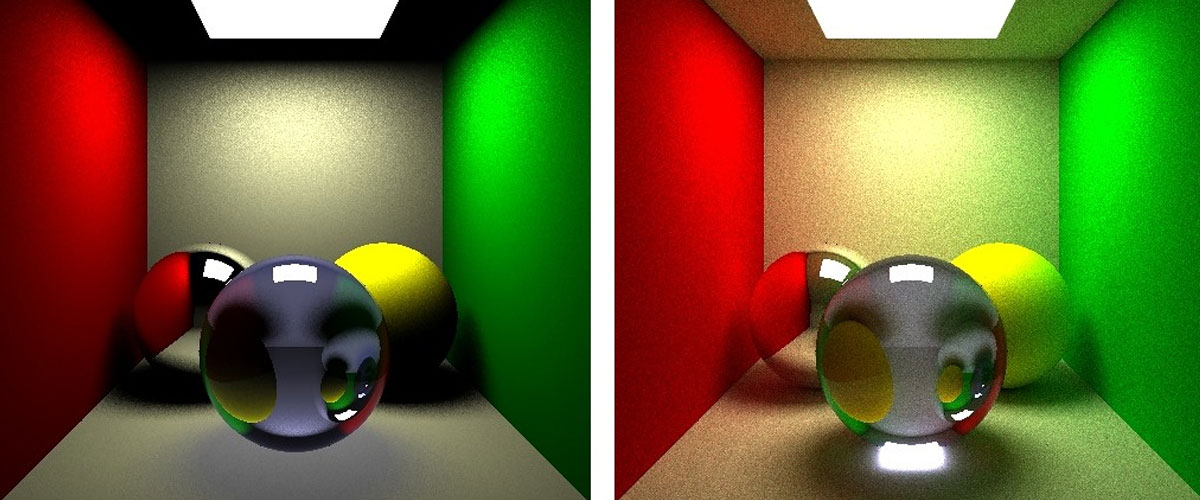
This simulation can be compared to a complex game of three-dimensional billiards, where light rays bounce between surfaces, losing energy with each interaction and taking on different colors depending on the materials they encounter.
The virtual model
Illumination models are the mathematical formulas that determine how light interacts with surfaces. They fall into two categories:
- Local models: consider only direct lighting, ignoring light bounces between different surfaces. They are fast but less realistic.
- Global models: also calculate indirect lighting, simulating the light bounces that create effects such as color bleeding (when the color of an object “bleeds” onto nearby surfaces).
The choice of model drastically affects both visual quality and rendering times, requiring a balance between realism and performance.
Types of lighting effects

Direct lighting
Direct lighting simulates light that strikes a surface directly from a light source. It includes:
- Directional lights: emit parallel rays, like the sun. They create sharp, uniform shadows.
- Spot lights: project light in a specific direction with a cone of influence, like a spotlight.
- Point lights: emit light in all directions from a specific point, like a light bulb.
Global illumination
Global illumination (GI) simulates the complex behavior of light bouncing between surfaces. The main techniques include:
- Ray tracing: traces the path of light rays through the scene, calculating reflections and refractions.
- Radiosity: calculates the transfer of light energy between surfaces, particularly effective for interior scenes.
- Photon mapping: simulates the behavior of photons, excellent for effects such as caustics (concentrations of light created by reflective or refractive surfaces).
Atmospheric effects
Atmospheric effects enrich the render by simulating phenomena such as:
- Volumetric lighting: displays light beams through participating media such as fog or dust.
- God rays: visible rays of light filtering through openings or clouds, creating dramatic effects.
- Atmospheric scattering: simulates the scattering of light in the atmosphere, essential for rendering realistic landscapes and skies.
Advanced lighting techniques
Ambient occlusion
Ambient occlusion (AO) is a technique that simulates the attenuation of ambient light in hard-to-reach areas such as corners, folds, and crevices. This effect adds depth and realism to scenes, highlighting the three-dimensional structure of objects.
Subsurface scattering
Subsurface scattering (SSS) simulates the penetration and diffusion of light inside translucent materials. Think of light passing through a hand lit from behind: you don’t see just the surface, but the light spreading through the tissue. This effect is essential for realistic rendering of skin, wax, marble, and other semi-transparent materials.
Subsurface scattering
Image-Based Lighting (IBL) uses HDR images of the real environment to light 3D objects. It is like wrapping the scene in a spherical photograph of the environment, allowing objects to receive lighting consistent with the context they will be placed in.
Practical applications
Architectural rendering
In architectural rendering, lighting effects are essential for conveying the atmosphere of spaces and showcasing design choices. Natural light filtering through windows or the effect of lamps and light fixtures defines how spaces are perceived
Product visualization
In product visualization, strategic lighting highlights shapes, materials, and details, creating eye-catching images for catalogs and promotional material. Techniques such as HDRI lighting ensure a faithful representation of materials.
Cinematic effects
In animation and visual effects, lighting effects create atmosphere and guide the viewer’s attention. From the faint glow of a distant spaceship to the blinding explosion of a supernova, light tells stories and evokes emotions.
Tools and software
Rendering engines
Rendering engines differ in their algorithms and approaches to lighting:
- Biased engines: Use approximations to speed up rendering, sacrificing some physical accuracy.
- Unbiased engines: Aim for maximum physical accuracy, requiring more computational resources.
- Hybrid engines: Combine different techniques to balance quality and speed.
Related terms
Volumetric rendering – A complementary technique used to simulate lighting effects in translucent materials, fog, or complex environments.
- Ray tracing – A rendering technique that traces the path of light rays through a scene, calculating reflections, refractions, and shadows with high physical precision.
- Global illumination – A lighting calculation system that takes into account not only direct light from sources but also light bounces between the surfaces of the scene.
- HDRI (High Dynamic Range Imaging) – A high dynamic range image format used for image-based lighting in 3D rendering.
- Caustics – Light effects created by the concentration of reflected or refracted rays, such as the light patterns on the bottom of a swimming pool or through a glass.
- Ambient occlusion – A technique that simulates the darkening of areas that ambient light can hardly reach, adding depth and realism to rendered images.